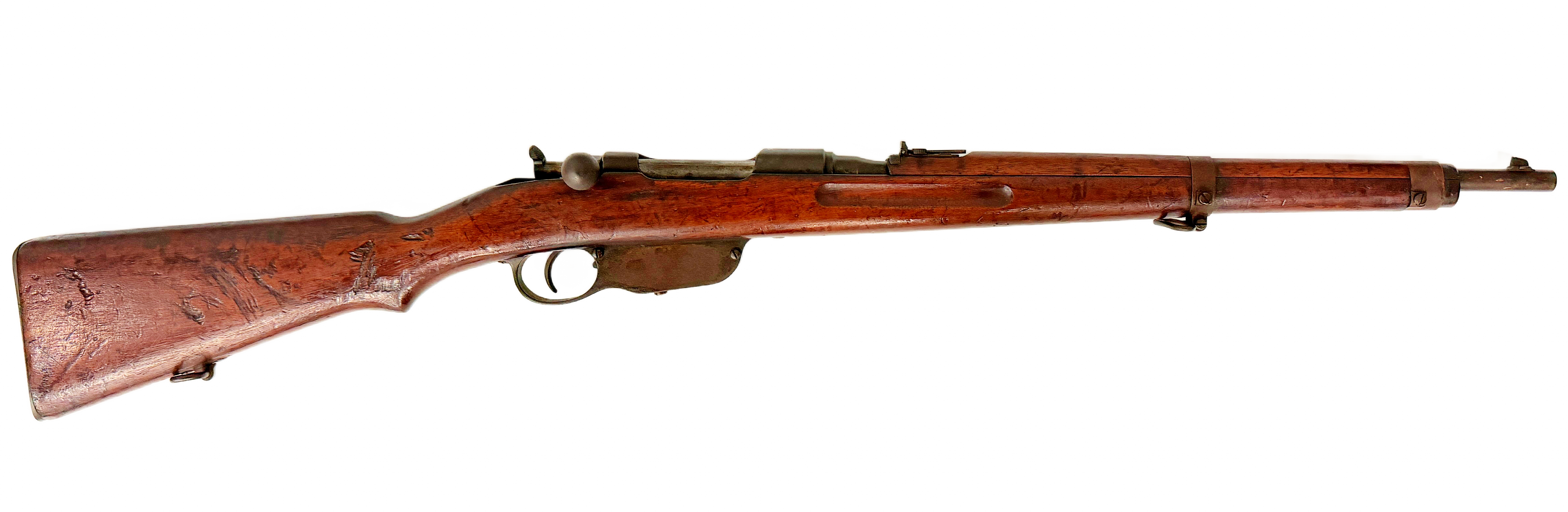


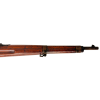
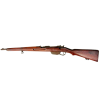
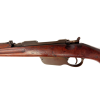
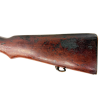
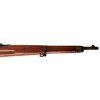
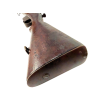
Original Austro-Hungarian Steyr M95 "Mannlicher Straight-Pull" Action Carbine
SKU: 912
Original/Reproduction: All-Original
Availability: In-Stock
Manufacturer: Ferdinand Mannlicher
Date Manufactured: 1905
Model: M95
Serial Number: 8836 G
Caliber: 8×50mmR Mannlicher
En Bloc Clip: 5-round internal box magazine en-bloc clip
Action Type: Bolt
Barrel Length: 500 mm (19.7 in) (or about 19 to 20 inches)
Bore Condition: 9/10 - Very Bright
Condition: Very Good
Mechanically: Excellent
Price: $995.00
Seller Type: Classification: C&R / FFL
Seller ID: JMW
Seller Code: PS200
Return Policy: 3-day inspection and return policy on used guns and accessories.
Description
This Original Austro-Hungarian Steyr M95 Mannlicher Straight-Pull Action Carbine in very good condition, representing one of the most distinctive and mechanically innovative military rifle designs fielded by the Austro-Hungarian Empire. Compact, rugged, and exceptionally fast to operate, the Mannlicher M95 became an iconic service arm of the First World War and remained in military use throughout Central and Eastern Europe well into the Second World War era.
Designed around Ferdinand Ritter von Mannlicher’s straight-pull bolt system, the M95 eliminated the conventional rotating motion required to unlock and lock the bolt on most contemporary military rifles. Instead, the shooter simply pulls the bolt handle directly rearward and pushes it forward again. Internal helical locking surfaces rotate the bolt head automatically during operation, providing secure lockup while allowing exceptionally rapid cycling.
The Mannlicher M95
The Mannlicher M1895, commonly known as the M95, was adopted by Austria-Hungary in 1895 as a successor to earlier Mannlicher straight-pull rifles. Production was principally undertaken by Österreichische Waffenfabriks-Gesellschaft (ÖWG) at Steyr, Austria, with additional production at the Hungarian state arms factory in Budapest.
The M95 family was manufactured in several configurations, including long infantry rifles, short rifles, and carbines intended for cavalry and other troops requiring a more compact weapon. The shorter M95 variants offered substantially improved portability compared with the full-length infantry rifle while retaining the same basic straight-pull operating system.
During the First World War, M95 rifles and carbines saw extensive service with Austro-Hungarian forces on the Eastern, Italian, Balkan, and Romanian fronts. Following the dissolution of the Austro-Hungarian Empire in 1918, enormous quantities remained in the inventories of Austria, Hungary, Bulgaria, Yugoslavia, and other European nations.
Distinctive Straight-Pull Action
The defining feature of the M95 is its ingenious Mannlicher straight-pull bolt action. Unlike a Mauser, Enfield, or Mosin-Nagant, the operator does not manually rotate the bolt handle before pulling it rearward. A direct rearward movement operates the internal mechanism and rotates the bolt head out of engagement with the receiver.
Pushing the bolt forward strips a cartridge from the magazine and chambers it while the mechanism rotates and locks the bolt head into battery.
This system provided the M95 with an unusually high potential rate of aimed fire for a manually operated military rifle. Austro-Hungarian troops consequently nicknamed the rifle “Ruck-Zuck,” reflecting the rapid back-and-forth motion of its action.
Mannlicher En-Bloc Magazine System
Another important characteristic is the rifle's Mannlicher en-bloc clip-loading system. Rather than loading loose cartridges individually into a conventional internal magazine, ammunition was inserted as a complete cartridge-loaded clip.
The clip remained inside the magazine while the cartridges were being fired. After the final cartridge was chambered, the empty clip was released through an opening in the bottom of the magazine housing.
This arrangement allowed soldiers to reload very quickly and was an important feature of several Mannlicher military rifle designs of the period.
Caliber and Later Military Conversions
M95 rifles were originally chambered for the Austro-Hungarian 8×50mmR Mannlicher cartridge. Beginning during the interwar period, many surviving rifles and carbines were converted to the more powerful 8×56mmR M30 cartridge.
Austrian-converted examples are commonly associated with an “S” marking on the barrel or receiver area, while Hungarian conversions may display different markings. Because both original and converted M95 firearms survive today, the actual caliber of an individual example should always be established from its markings and chamber configuration rather than assumed from the model alone.
For collectors, an unaltered 8×50mmR example can be particularly interesting, while officially converted 8×56mmR examples represent another important chapter in the M95's long service history.
Carbine Configuration
The compact configuration of this example gives the M95 a distinctive appearance and handling characteristics compared with the much longer M95 infantry rifle.
Short Mannlicher variants were particularly well suited to mounted troops, artillery personnel, support units, and other soldiers for whom the length of a standard infantry rifle could be cumbersome. Various short configurations and subsequent arsenal alterations existed during the M95's lengthy service life, making careful examination of sights, sling arrangements, stock fittings, markings, and dimensions important when determining the precise variation.
Collectors should also be aware that some M95 rifles were subsequently shortened or rebuilt by military arsenals. For this reason, the exact configuration of a particular specimen is best identified through its individual physical features and markings.
Military Service and Historical Significance
The M95 is inseparably associated with the armies of the Austro-Hungarian Empire during World War I. Austro-Hungarian soldiers carried Mannlicher rifles across some of the most difficult battlefields of the conflict, from the mountains of the Italian Front to the vast campaigns against Imperial Russia.
Its history did not end with the Armistice.
Following the collapse of Austria-Hungary, the empire's military equipment was divided among successor states and neighboring countries. M95 rifles consequently continued to serve through the interwar years, and substantial numbers remained in military inventories during World War II.
This unusually long service history makes the M95 an excellent representative firearm for collections centered on either World War I or the military development of Central Europe during the first half of the twentieth century.
Collector Features
This original M95 carbine offers many of the characteristics sought by collectors of Imperial Austrian and Austro-Hungarian military firearms, including:
- Original Austro-Hungarian military M95 pattern
- Mannlicher straight-pull bolt-action mechanism
- Compact military carbine configuration
- Mannlicher en-bloc clip-fed magazine system
- Military-pattern stock and furniture
- Period iron sights
- Historic Austro-Hungarian military design
- World War I-era service heritage
- Continued historical relevance through the interwar and World War II periods
- Very good overall condition
The metal components retain an attractive military appearance with the expected evidence of age and service. The stock remains very presentable, showing the handling marks and minor wear expected on an original military firearm of this age. Such evidence of use contributes significantly to the historical character of an authentic military-surplus M95.
The straight-pull action is the centerpiece of the design and remains one of the most fascinating mechanical systems found on a major First World War service rifle.
Historical Collector Appeal
More than a century after its introduction, the Steyr M95 remains immediately recognizable. Its short receiver, prominent straight bolt handle, Mannlicher magazine housing, compact stock profile, and unusual action distinguish it from the Mauser, Lee-Enfield, Springfield, and Mosin-Nagant systems used by other major powers.
For the military firearms collector, an original M95 carbine provides a tangible connection to the final decades of the Habsburg Empire and to the enormous multinational army that fought under Emperor Franz Joseph I and, later, Emperor Charles I.
It also illustrates a fascinating period of firearms development when military designers were searching for ways to increase the speed and efficiency of manually operated repeating rifles before semiautomatic service rifles became practical on a large scale.
Specifications
Model: Mannlicher M95 / M1895
Type: Military Carbine / Short Straight-Pull Rifle
Country of Origin: Austria-Hungary
Action: Mannlicher Straight-Pull Bolt Action
Magazine System: Internal Magazine Using Mannlicher En-Bloc Clip
Capacity: 5 Rounds
Original Service Cartridge: 8×50mmR Mannlicher
Common Later Conversion: 8×56mmR M30
Era: Late 19th Century through World War II
Primary Historical Association: Austro-Hungarian Armed Forces / World War I
Condition: Very Good
This Original Austro-Hungarian Steyr M95 Mannlicher Straight-Pull Action Carbine is an impressive example of one of the most mechanically distinctive military rifles of the First World War. Combining its compact military configuration, rapid straight-pull action, Mannlicher en-bloc feeding system, and unmistakable Austro-Hungarian heritage, it would make an excellent addition to an advanced collection of WWI firearms, Austro-Hungarian militaria, Mannlicher rifles, or historic European military arms.
A very attractive original military carbine with tremendous historical character and one of the most interesting bolt-action mechanisms of its era.
